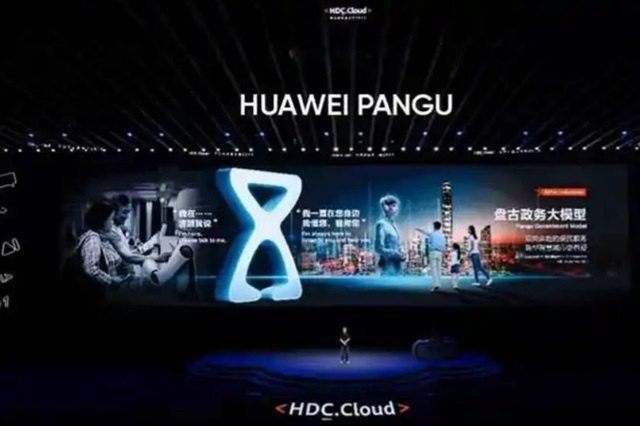
Huawei is trying to restore the profile of PanguLM at a time when China's large AI model race is entering a tougher phase.

At Huawei Developer Conference (HDC) 2026, CEO of Huawei Technologies Consumer Business Group Richard Yu made a rare public appearance to back PanguLM. He acknowledged that the model had not performed well enough in the past, said he took over the business in autumn 2025, and set a goal of making PanguLM the world's leading large model.
The statement points to a turbulent two-year period for PanguLM, once promoted by Huawei among China's earliest large models.
Huawei officially launched PanguLM in 2021, before generative AI became a global market force. The company had already expanded into natural language processing, computer vision, and scientific computing, aiming to build a self-developed AI ecosystem through Ascend AI chips and Huawei Cloud.
But after ChatGPT emerged in late 2022 and global AI competition accelerated, PanguLM gradually lost market visibility.
Plagiarism claims damaged PanguLM's AI standing
The real turning point came in 2024, when PanguLM became caught in controversy over alleged model wrapping and plagiarism. Chinese academics and open-source communities questioned whether parts of PanguLM were highly similar to certain open-source models, triggering debate around related technical reports and test results.
Huawei denied the allegations and said PanguLM was developed on its own architecture and the Ascend platform. Even so, the episode damaged the brand and raised doubts over Huawei's competitiveness in foundation model innovation.
China's AI market was also changing quickly. Baidu's Ernie Bot, Alibaba's Qwen, Tencent's HY, ByteDance's Doubao, and later DeepSeek turned the sector into a crowded contest. PanguLM retained some share in government, enterprise, and industrial AI markets, but its developer ecosystem and model influence moved closer to the margins.
To reverse the slide, Huawei launched a new round of restructuring in 2025. The original PanguLM team was reorganized, a move widely read by the market as a sign of dissatisfaction among senior Huawei executives. Yu was later given a larger AI strategy role and took direct control of PanguLM's development direction.
At HDC 2026, Yu spoke publicly about that process for the first time. He said PanguLM, one of China's earliest large models, had started with a first-mover advantage, making its later underperformance unacceptable. Since taking over in 2025, he said, he repositioned PanguLM at the core of Huawei's AI strategy, aiming to rebuild competitiveness through the integrated strength of software, hardware, chips, and cloud.
openPangu 2.0 marks Huawei's reset
openPangu 2.0, unveiled at HDC 2026, is being positioned as a key step in Huawei's effort to revive PanguLM. The new model uses training and inference architecture optimized for the Ascend platform. openPangu 2.0 Pro reaches 505 billion parameters and focuses on upgraded AI agent capabilities.
Huawei said it is also expanding open-source access, covering pre-training code, post-training workflows, and inference computing power, in an effort to draw more developers into its ecosystem.
Beyond cloud models, Huawei announced that a 30-billion-parameter on-device large model will soon arrive on terminals powered by Kirin chips. Quantization and pruning technologies will be used to reduce computing requirements.
Yu said the deep coordination of Ascend, PanguLM, Kirin, and HarmonyOS could become Huawei's key advantage against other AI competitors.
Trust and compute remain the real tests
Market analysts said PanguLM's challenge now extends beyond the model itself. After the plagiarism controversy and its decline in market visibility, Huawei must rebuild developer trust, expand the ecosystem, and narrow the gap with leading global models under limited computing resources.
For Huawei, the PanguLM reboot is not only a product relaunch. It is a test of whether the company can turn its full-stack AI strategy into real developer momentum.
Article translated by Levi Li and edited by Jack Wu