
Despite lagging growth in the global economy, smartphone and tablet applications that use one-glass-solution (OGS) touch screen technology are becoming increasingly popular in the market and demand for the technology at present is showing no visible signs of slowing down. As a way to meet increasing demand for touch screen products, China-based Truly Optoelectronics invested approximately NT$500 million (US$17 million) back in 2012 to construct a plant geared towards producing OGS technology. Chairman of the company, Chien-Hwa Lee, talked about Truly's investment and offered some insights into the way he sees touch screen technology developing in the future, particularly within China.
Q. In a market where smartphone and tablet products are growing in demand but yet have increasingly shorter life-cycles and greater price competition, how is Truly reacting to these trends, especially in terms of development in China?
A. Smartphone and tablet prices are dropping rapidly in China. However, most of those drops are for entry-level products while mid-range and high-end products are maintaining steady pricing. Granted, sooner or later prices will drop for those products as well, but at a much more reasonable rate. In terms of Truly's touch screen product sizes used in China, most entry-level ones are sized below 4-inch and are priced at approximately US$7-8 while high-end sizes range from 4.3-, 4.5- and 4.7-inch, and are priced about US$12-13.
Q. What predictions do you have for smartphone development in China during 2013?
A. Smartphones made by China-based smartphone vendors will vary in price during the time period. Entry-level smartphones are expected to remain as low as CNY$399 (US$64) and may drop even lower, while high-end ones may be priced around CNY$2,000. Also, approximately 16% of handset users in China were using a smartphone as of the third-quarter 2012, but over the next 2-3 years that percentage is expected to grow rapidly and may even reach the global standard of approximately 60%. To meet these trends, Truly plans to expand investment for capacitive touch screens in 2013, and for the most part will not focus on entry-level products.
Q. Truly began mass producing OGS touch screens in October 2012. Can you tell us about their production development?
A. Back in October we began mass producing five million substrates, three million of which were thin-film type projected capacitive touch screens while G/G touch screens were at about 1.2 million units, and OGS touch screens at 800,000. We are looking to adjust some production lines in 2013 in order to produce more OGS solutions. The costs involved in the adjustment are huge, but we plan to invest in another production line in 2013 which should bump up overall production of thin-film type projected capacitive technology by two million units.
As a result, we estimate that 70% of our production will be allocated to OGS products in 2013 while the rest is expected to go to thin-film type projected capacitive touch screens. This will allow Truly to become the largest OGS player in China during 2013, with production expected to reach six million substrates.
Q. Truly currently also produces small-size OGS solutions. Compared to large-size ones, are there any pricing or cost advantages?
A. Small-size OGS production is faster and has better yields because it does not have to go through secondary hardening unlike large-size OGS. However, using a lithography process to produce small-size OGS is ineffective, as a very limited number of substrates can be produced at a time whereas 10 or even 20 or more large-size ones can be produced during the same period. Basically, there are not distinct cost advantages for one over the other but small-size OGS production can achieve 600MPa and above strengthening, making it suitable for thin bezel designs. Large-size OGS production is only able to reach 300MPa.
Q. As Windows 8 is further being used in notebook applications, is Truly planning to expand its production in any way?
A. Truly believes there is more potential for growth in the tablet market. We currently produce 5.7-inch touch screen products for use in smartphones but are looking to make 6-inch smartphone products and perhaps even 7-inch ones in the future due to expected demand in the market. We do not possess advantages in the market for touch screens sized 10-inch and above typically used in notebook products and are more interested in aiming at the 10-inch and below tablet market.
The proportion of notebooks that use touch screens has increased since the release of Windows 8, and we believe this trend will persist for at least another 2-3 years despite industry claims stating voice- and gesture-control will be at the forefront for notebook interface technology. In the future, all-in-one (AIO) PCs sized 21-inch are likely to use touch screens, which might even be cut from 5G or 6G lines.
Q. Truly has invested in Taiwan-based HannStar Display. Does the company have any other plans for further cooperation with Taiwan-based companies?
A. There are definitely plans for further cooperation with Taiwan-based companies such as HannStar in the future. At present, Truly is aimed at cooperating with system makers in China but there is still a lot of room for development in this field with Taiwan-based system makers. We also plan to extend cooperation with Taiwan-based touch screen IC makers.
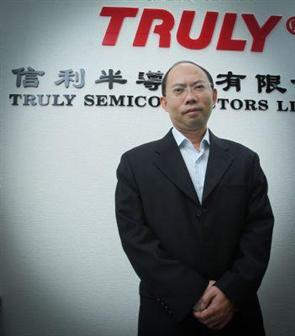
Truly chairman Chien Hwa-Lee talks about the company's plans for 2013
Photo: Shihmin Fu, Digitimes, February 2013
Article translated by Alex Wolfgram