

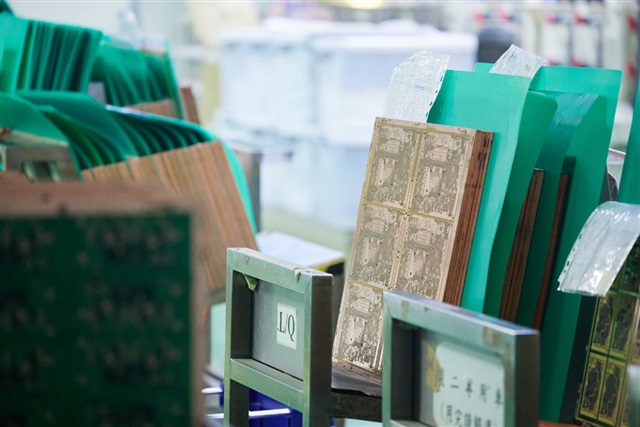
Niche printed circuit board (PCB) maker EISO Enterprise said that 2026 industry demand has returned to post-pandemic highs as AI applications spread across multiple segments, while chairman Jian Rong-kun said the chance of a market reversal or an AI bubble burst remains low. But since 2025, shortages and price increases in high-frequency, high-speed copper-clad laminate (CCL) have remained a shared operational challenge for PCB makers.
After a downturn from 2023 to 2025, EISO said demand is rebounding in 2026 as rapid AI development lifts specifications for peripheral equipment and sharply increases demand for high-end PCBs. Order visibility has improved to three months, and the company expects revenue and profit to grow strongly as price hikes take effect in the second half of the year.
Material costs surge
As demand for upstream key materials rises, EISO said prices have climbed, supply has tightened, and lead times have lengthened. The company said cumulative cost increases for CCL-related materials have already exceeded 200%, and even placing orders 8 to 12 months in advance does not guarantee on-time delivery or locked-in prices, making this one of the biggest uncertainties for 2026 operations.
To address the issue, EISO has negotiated pricing with downstream customers. Some price increases took effect in the second quarter, and 70% to 80% of orders will be billed at the new prices by the third quarter. With material costs still trending higher, the company expects it can fully pass through cost pressures in the fourth quarter. It is also pursuing a strategy of diversified supply, early material stocking, and flexible substitution to strengthen supply resilience and reduce risks from shortages, delays, and single-source dependence.
The company said the challenge is especially acute in high-end applications such as AI servers, satellite communications, and aerospace and defense, where material specifications are special and qualification cycles are long. EISO is continuing to refine substitute solutions and supply management to ensure stable delivery for upcoming customer projects.
Pushing up the AI, aerospace, and defense mix
EISO said it is actively pushing a shift toward higher-value products, targeting AI servers, data centers, industrial PCs (IPCs), automotive electronics, and drones, while also expanding into low Earth orbit (LEO) satellites and aerospace and defense sectors. The revenue share from these applications reached double digits in the first half of 2026, and the company expects their share in 2027 to grow several times from current levels as customer projects ramp, improving its product mix and profitability.
PCB operations account for about 80% of EISO's revenue. With AI functions increasingly being adopted in industrial control, automation, and edge computing equipment, IPC products continue to benefit from specification upgrades and remained the main revenue source in the first half of 2026. In addition, AI server backup battery unit (BBU) products have recently entered the ramp-up phase and were the main driver behind record revenue in July.
EISO said AI servers are moving toward higher power and higher density, which is also raising PCB requirements for high reliability, more layers, better heat dissipation, and more precise manufacturing. The company said it maintains long-term, stable partnerships with major domestic customers, continues supplying existing products and is also investing in multiple new product developments to lay the groundwork for future growth.
Taiwan production base expands
In response to global supply chain restructuring, all of EISO's production bases are concentrated in Taoyuan, Taiwan. As demand for high-end products grows quickly, the company said its newly opened second-phase plant in Guishan has officially begun operations and will start contributing revenue from the third quarter. The first batch of equipment will be installed by the end of 2026, and once the new plant is fully equipped, total capacity will rise to 1.5 times its original level.
EISO said the second-phase Guishan plant integrates existing PCB capacity with high-precision process equipment, automated smart production lines, and digital process management systems, comprehensively improving production efficiency, quality management, and delivery capability. The company added it will provide stronger capacity support for AI, high-performance computing, and aerospace and defense products while meeting international customers' demand for non-China supply chains and local manufacturing.
Article translated by Lily Hess and edited by Ysi Chen