
In 2005, Taiwanese electronic company BenQ—then operating under its parent company Qisda—was riding high as the world's fourth-largest mobile phone brand. That momentum led to a bold, if ultimately ill-fated, decision: the acquisition of Siemens' struggling mobile handset division.
The move ended in disaster. By 2006, BenQ had incurred losses of over NT$27 billion (approx. US$884 million), prompting the company to halt further investment and file for bankruptcy protection in Europe. The failure became one of Taiwan's most infamous merger missteps, a cautionary tale still cited in business circles today.
But from that low point emerged a transformative pivot—one that redefined the company's future.
A strategic split: brand vs. manufacturing
Looking back, Qisda chairman Peter Chen recalled 2006 as a turning point. The losses forced the company to reconsider everything, Chen said in an interview. That was when the leadership made the strategic decision to separate the brand operations from the contract manufacturing business.
The company reorganized into two distinct entities: BenQ would focus exclusively on brand development, while Qisda would concentrate on manufacturing and OEM operations. Between 2006 and 2013, Chen led BenQ's product and technology center, where he helped reshape the brand's identity, product lines, and organizational structure.
Flying under the radar—with billions in revenue
Since the split, BenQ has quietly engineered a steady comeback, focusing on niche markets and high-margin products. Despite remaining a private company and avoiding the scrutiny—and visibility—that comes with being publicly listed, BenQ has grown into a business generating hundreds of billions of New Taiwan Dollars annually in revenue.
Chen explained that the company's strategy was clear: focus on differentiation and value. Under this approach, BenQ shifted toward high-end market segments and professional branding. Today, its core portfolio centers on information display technologies, particularly monitors and projectors. Its projectors rank among the top three brands globally, and its early, substantial investment in esports monitors has also delivered notable success.
Despite its scale, BenQ maintains a relatively low profile, largely due to its status as a privately held company. Chen noted that the business remains profitable with strong margins and added that, if the right opportunity arises, the company may explore new organizational adjustments in the future.
A Taiwanese brand, deeply rooted at home
Since gaining independence from Qisda in 2006, BenQ has operated autonomously, focusing on product innovation, value marketing, and tailored differentiation. Most of its supply chain now links directly with Taiwan's manufacturing ecosystem, with only minimal support from Qisda.
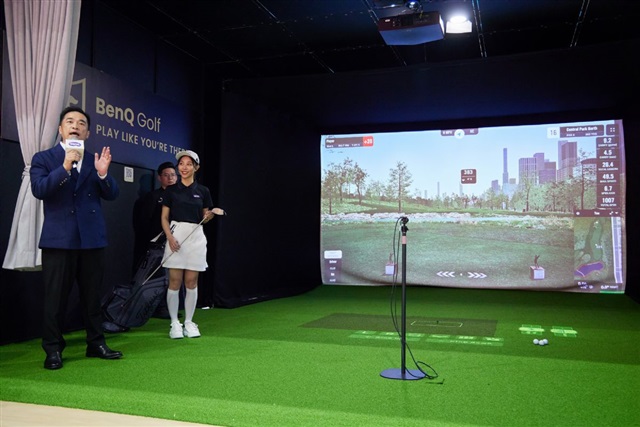
At Computex 2025, BenQ showcased its latest innovations across three major AI-powered domains: smart living, smart education, and smart business. One of the standout displays was a cutting-edge indoor golf simulator, combining proprietary 4K projection technology with AI-driven motion analysis.
The system features the world's first 4K projector designed specifically for golf simulation, paired with an AI posture module and high-end motion tracking technology. It delivers real-time swing analysis and feedback—even before the user strikes the ball—transforming it into a virtual coach. According to Chen, the product now commands over 30% market share in North America and boasts "very healthy" profit margins.
It's a perfect example of how the company is pushing into high-value sectors, Chen said. It's not just making products—it's creating intelligent experiences.
Nearly two decades after one of Taiwan's most public business failures, BenQ has quietly emerged as a mature, profitable, and strategically focused brand. Its story is one of painful lessons and bold reinvention—a reminder that even in the wake of a corporate catastrophe, there can be a second act.
Article translated by Elaine Chen and edited by Joseph Tsai