

Xiaomi has entered China's range-extended electric vehicle market with two large intelligent SUVs, expanding beyond battery-only models as it confronts slowing deliveries, renewed losses and intensifying competition from technology groups including Huawei and ByteDance.
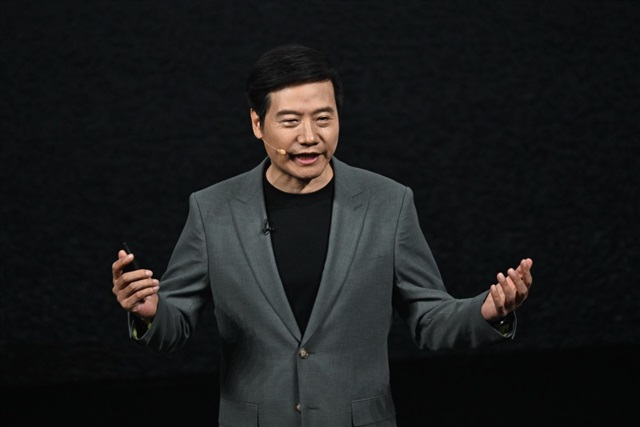
At its second automotive technology launch on July 30, Xiaomi chairman Lei Jun introduced the Kunlun vehicle architecture and two range-extended SUVs, the seven-seat SkyNomad N90 and five-seat N70. The launch broadens Xiaomi's technology portfolio beyond its SU7 saloon and YU7 SUV, both battery-electric vehicles positioned more heavily around performance.
Shanghai Securities Journal reported that the expansion comes under dual pressure to meet Xiaomi's annual delivery target and protect profitability. The group is also entering a market in which technology companies are increasingly competing through vehicle production, intelligent-driving systems, cockpit software and partnerships with established carmakers.
Xiaomi targets China's family SUV market
Range-extended electric vehicles use electric motors for propulsion and a petrol engine as an onboard generator, combining an electric driving experience with the ability to refuel on longer journeys. Alongside battery-electric and plug-in hybrid vehicles, the technology has become one of the main powertrain routes in China's new-energy vehicle market.
Xiaomi is positioning the SkyNomad series as an "intelligent, reconfigurable, large-space SUV" aimed primarily at families, in contrast with the more performance-focused SU7 and YU7.
The N90 uses a three-row, seven-seat layout, while the N70 has two rows and five seats. The larger model offers movable and rotating seats with 18 seating or reclining configurations for work and leisure. Higher-specification Max versions also include comfort features such as a small refrigerator and seats with built-in massage functions.
Bloomberg reported that the fully equipped N70 Max will start at CNY259,900 (approx. US$38,400), while the N90 will start at CNY299,900. The latter is priced below the opening price of the top-specification YU7 and close to Li Auto's L6 SUV, which starts at CNY279,800.
Credit: Bloomberg
The flagship N90 Max combines a 76-kilowatt-hour battery, a 1.5-litre turbocharged range extender and a 60-litre fuel tank. Xiaomi said the vehicle can travel up to 1,705 kilometres with a full battery and fuel tank.
The SkyNomad series is built on Xiaomi's new Kunlun architecture, developed specifically for larger SUVs with adaptable interiors. Pre-orders opened on July 30, with market launch scheduled for September, according to Reuters.
Xiaomi plans to begin selling vehicles overseas in 2027, although it has not said whether the SkyNomad range will be included in that expansion.
Credit: China Passenger Car Association
Delivery targets collide with margin pressure
Xiaomi's range-extended vehicles are intended to broaden its market after the company progressed from factory construction and supply-chain integration to mass production following its March 2021 automotive launch.
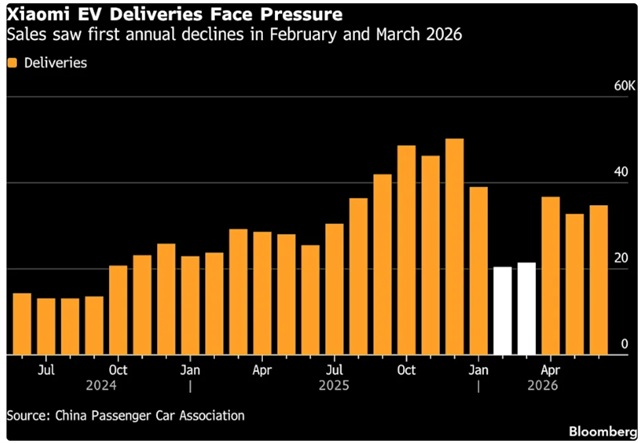
Lei has targeted 550,000 deliveries in 2026, but Xiaomi shipped only 180,000 vehicles in the first half. Meeting the goal would require average monthly deliveries of about 60,000 for the rest of the year.
China Passenger Car Association data show first-half deliveries fell 20%, with the first year-on-year monthly declines recorded in February and March. Part of the drop reflected production-line adjustments ahead of the second-generation SU7.
The YU7 still drew hundreds of thousands of orders within hours of launch, but SkyNomad enters a weaker range-extended market. Aito sales fell more than 30% year on year in June, despite the technology previously helping Seres return to profit through its partnership with Huawei.
Analyst Mei Songlin said Xiaomi may seek to replicate Aito's success by using vertical integration to simplify production and cut costs. Diversifying powertrains has worked for others, with plug-in hybrids accounting for roughly half of BYD's sales, but Xiaomi's outcome remains uncertain.
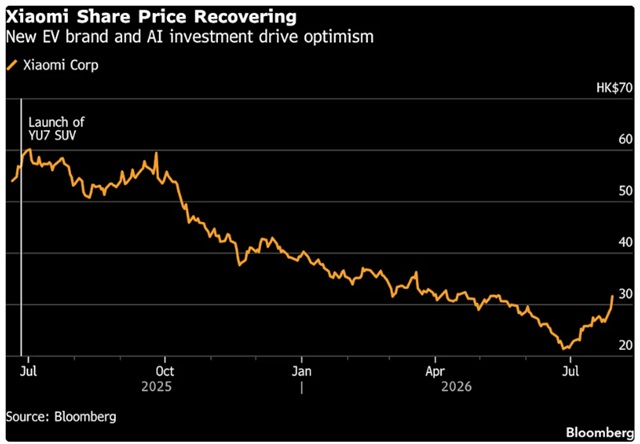
Profitability has also weakened. Xiaomi's smart EV and AI innovation operations posted a first-quarter gross margin of 20.1%, down 3.1% year on year and 2.6% sequentially, alongside a CNY3.1 billion operating loss.
Its core smartphone business is also under pressure. Counterpoint reported a double-digit decline in second-quarter shipments as higher memory-chip costs weighed on entry-level and mid-range demand.
Huawei and ByteDance widen the contest
Xiaomi's expansion comes as other Chinese technology groups deepen their automotive presence through different models.
Huawei works with carmakers rather than manufacturing vehicles itself. Its full-stack and component partnerships now span more than 25 brands and 50 models, while installations of its Qiankun intelligent-driving system have exceeded 1.9 million. Huawei expects combined Qiankun and HarmonyOS cockpit installations to top 2 million by the end of August 2026.
The company plans to invest more than CNY18 billion in automotive intelligence in 2026. Cloud computing capacity has risen from 2.8 EFLOPS in 2023 to 60 EFLOPS, while spending on computing capacity alone is expected to approach CNY10 billion this year. Huawei also plans to invest another CNY70 billion to CNY80 billion over the next five years.
ByteDance has denied plans to build vehicles directly, but Volcengine and Doubao are expanding through automotive software. Volcengine's AI cockpit solutions have been installed in more than 7 million vehicles from carmakers including BYD, Geely, Changan, Nio and Li Auto.
Seres' new Saidou brand is also developing its first production model, the AIVA, with Volcengine and Doubao.
The strategies differ sharply: Xiaomi is broadening its vehicle and powertrain range, Huawei is scaling intelligent-driving and cockpit systems through partnerships, and ByteDance is targeting cloud and AI software. The next phase will test whether those positions can deliver sustained sales and profits.
Article edited by Jerry Chen